Friday, May 16, 2014

Don't eat the car! Not the car!


The Power of the Dog by Rudyard Kipling


There is sorrow enough in the natural way
From men and women to fill our day;
And when we are certain of sorrow in store,
Why do we always arrange for more?
Brothers and Sisters, I bid you beware
Of giving your heart to a dog to tear.

Buy a pup and your money will buy
Love unflinching that cannot lie--
Perfect passion and worship fed
By a kick in the ribs or a pat on the head.
Nevertheless it is hardly fair
To risk your heart for a dog to tear.

When the fourteen years which Nature permits
Are closing in asthma, or tumour, or fits,
And the vet's unspoken prescription runs
To lethal chambers or loaded guns,
Then you will find--it's your own affair--
But...you've given your heart for a dog to tear.

When the body that lived at your single will,
With its whimper of welcome, is stilled (how still!);
When the spirit that answered your every mood
Is gone--wherever it goes--for good,
You will discover how much you care,
And will give your heart for the dog to tear.

We've sorrow enough in the natural way,
When it comes to burying Christian clay.
Our loves are not given, but only lent,
At compound interest of cent per cent.
Though it is not always the case, I believe,
That the longer we've kept 'em, the more do we grieve:
For, when debts are payable, right or wrong,
A short-time loan is as bad as a long--
So why in Heaven (before we are there)
Should we give our hearts to a dog to tear?

Labels: ,

Monday, January 03, 2011

Just because you are a character doesn't mean that you have character.

I grew up hearing this and just assumed Grandma Hartman made it up. However, I didn't realize until now that Sir Walter Scott (1771-1832) was stealing her material.
Oh! what a tangled web we weave
When first we practise to deceive!
-from Marmion, Canto VI. Stanza 17.

Labels: ,

Friday, March 26, 2010

Robert Frost wrote it. I always remembered it because I never quite knew what he meant.

In honor of his birthday (1874-1963), a Robert Frost poem.

Nature's first green is gold,
Her hardest hue to hold.
Her early leaf's a flower;
But only so an hour.
Then leaf subsides to leaf.
So Eden sank to grief,
So dawn goes down to day.
Nothing gold can stay.

Labels:

Monday, December 14, 2009

Ah, youth is wasted on the wrong people.

Clearing off my desk today I came across something passed along by my grandmother. It was printed on the back of her friend's funeral program. According to Grandma, "This poem was a 'Dear Abby' column that Edie had handwritten & put into the back of her Bible."

I found it noteworthy and hope you will as well.
Prayer for the Aged
Lord, Thou knowest better than I know myself that I am growing older, and will someday be old.

Keep me from getting talkative and particularly from the fatal habit of thinking I must say something on every occasion.

Release me from the craving to try to straighten out everybody's affairs.

Keep my mind free from the recital of endless details - give me wings to get to the point.

I ask for grace enough to listen to the tales of others' pains. Help me to endure them with patience.

But seal my lips on my own aches and pains - they are increasing, and my love of rehearsing them is becoming sweeter as the years go by.

Teach me the glorious lesson that occasionally it is possible that I may be mistaken.

Keep me reasonably sweet. I do not want to be a saint; some of them are so hard to live with. But a sour old person is one of the crowning works of the devil.

Make me thoughtful, but not moody; helpful, but not bossy. With my vast store of wisdom, it seems a pity not to use it at all - but Thou knowest, Lord, that I want a few friends at the end.

-Author Unknown
  • Wisdom is with the aged, and understanding in length of days. -Job 12:12 (ESV)
  • "You shall stand up before the gray head and honor the face of an old man, and you shall fear your God: I am the Lord." -Lev 19:32 (ESV)

Labels:

Tuesday, November 03, 2009

This is a good one. We don't go out when it rains.

Sometimes folks are familiar with a phrase, but know not its origin. Below is a poem, the end of which is a rather famous expression.

For your reading pleasure, some Henry Wadsworth Longfellow:

The Rainy Day (1842)

The day is cold, and dark, and dreary
It rains, and the wind is never weary;
The vine still clings to the mouldering wall,
But at every gust the dead leaves fall,
And the day is dark and dreary.

My life is cold, and dark, and dreary;
It rains, and the wind is never weary;
My thoughts still cling to the mouldering Past,
But the hopes of youth fall thick in the blast,
And the days are dark and dreary.

Be still, sad heart! and cease repining;
Behind the clouds is the sun still shining;
Thy fate is the common fate of all,
Into each life some rain must fall,
Some days must be dark and dreary.

Labels:

Monday, October 12, 2009

Get in there you big furry oaf! I don't care what you smell!

I had to share this poem, recommended to me by one of my fellow elders, one who could empathize firsthand with the author.

THE PASSING OF THE OUTHOUSE
James Whitcomb Riley

We had our posey garden
That the women loved so well.
I loved it too but better still
I loved the stronger smell
That filled the evening breezes
So full of homely cheer
And told the night-o’ertaken tramp
That human life was near.
On lazy August afternoons:
It made a little bower
Delightful, where my grandsire sat
And whiled away an hour.
For there the summer morning
Its very cares entwined.
And berry bushes reddened
In the teeming soil behind.
All day fat spiders spun their webs
To catch the buzzing flies.
That flitted to and from the house
Where Ma was baking pies.
And once a swarm of hornets bold
Had built a palace there.
And stung my unsuspecting aunt –
I must not tell you where.
Then father took a flaming pole
That was a happy day –
He nearly burned the building up
But the hornets left to stay.
When summer bloom began to fade
And winter to carouse,
We banked the little building
With a heap of hemlock boughs.
But when the crust was on the snow
And the sullen skies were gray,
In sooth the building was no place
Where one could wish to stay.
We did our duties promptly;
There one purpose swayed the mind.
We tarried not nor lingered long
On what we left behind.
The torture of that icy seat
Would made a Spartan sob,
For needs must scrape the goose flesh
With a lacerating cob.
That from a frost-encrusted nail
Was suspended by a string –
My father was a frugal man
And wasted not a thing.
When grandpa had to “go out back”
And make his morning call,
We’d bundled up the dear old man
With a muffler and a shawl.
I knew the hole on which he sat
‘Twas padded all around,
And once I dared to sit there;
‘Twas all too wide, I found.
My loins were all too little
And I jack-knifed there to stay;
They had to come and get me out
Or I’d have passed away.
Then father said ambition
Was a thing small boys should shun,
And I must use the children’s hole
Till childhood days were done.
But still I marvel at the craft
That cut those holes so true;
The baby hole and the slender hole
That fitted Sister Sue.
That dear old country landmark!
I’ve tramped around a not
And in the lap of luxury
My lot has been to sit,
But ere I die I‘ll eat the fruit
Of trees I robbed of yore,
Then seek the shanty where my name
Is carved upon the door.
I ween the old familiar smell
Will soothe my jaded soul;
I’m now a man, but none the less
I’ll try the children’s hole.

Labels: ,

Thursday, August 21, 2008

What the Bible calls a “psychological edge”

Most are familiar with, at most, one hymn by Augustus Toplady, Rock of Ages. Here's another of which you should be aware. (HT Anthony Carter)

A Debtor to Mercy Alone

by Augustus Montague Toplady

A debtor to mercy alone,
Of covenant mercy I sing;
Nor fear, with Thy righteousness on,
My person and offering to bring.
The terrors of law and of God
With me can have nothing to do;
My Savior's obedience and blood
Hide all my transgressions from view.

The work which His goodness began,
The arm of His strength will complete;
His promise is yea and amen,
And never was forfeited yet.
Things future, nor things that are now,
Not all things below nor above
Can make Him His purpose forego,
Or sever my soul from His love.

My name from the palms of His hands
Eternity will not erase;
Impressed on His heart it remains
In marks of indelible grace.
Yes, I to the end shall endure,
As sure as the earnest is given
More happy, but not more secure,
The glorified spirits in heaven.
(emphasis mine)

Labels: ,

Tuesday, May 20, 2008

Why don't you make like a tree and get out of here.

As we recently planted 6 more baby trees in our yard to balance the adults and the adolescents, I was thinking about trees.

I drove by our old house and looked at the trees we planted 8 years ago. I drove by our older old house and looked at the trees we planted 12 years ago.

Wow, like spirituality, you don't really notice growth on a day to day basis, but inspect again after a few years and you might be surprised.

I've got a little black book with my poems in ... here's one for your edification.

Trees

I think that I shall never see
A poem lovely as a tree.

A tree whose hungry mouth is prest
Against the sweet earth's flowing breast;

A tree that looks at God all day,
And lifts her leafy arms to pray;

A tree that may in summer wear
A nest of robins in her hair;

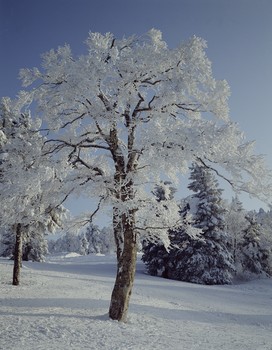
Upon whose bosom snow has lain;
Who intimately lives with rain.

Poems are made by fools like me,
But only God can make a tree.

-Sgt. Alfred Joyce Kilmer (1886-1918),
KIA at the Second Battle of Marne

Labels:

Sunday, March 25, 2007

Follow the yellow brick road.

A poem well known to many is one I memorized in high school and pondered then and have pondered many times thence. Sharing it on the anniversary of the author's birth (1874), I hope it will motivate you to ponder as well.


The Road Not Taken by Robert Frost
Two roads diverged in a yellow wood,
And sorry I could not travel both
And be one traveler, long I stood
And looked down one as far as I could
To where it bent in the undergrowth.

Then took the other, as just as fair,
And having perhaps the better claim,
Because it was grassy and wanted wear;
Though as for that the passing there
Had worn them really about the same.

And both that morning equally lay
In leaves no step had trodden black.
Oh, I kept the first for another day!
Yet knowing how way leads on to way,
I doubted if I should ever come back.

I shall be telling this with a sigh
Somewhere ages and ages hence:
Two roads diverged in a wood, and I--
I took the one less traveled by,
And that has made all the difference.

In high school I had my life mapped out, including who I would marry, where I would go to college, and what my careers would be afterward.

I hope this doesn't come as a shock to you, but none of those things came true. Of course, we know that God ordains our steps. I would even say He has "line item" veto power and He's not afraid to use it, and it's in our best interest when He does.
The heart of man plans his way,
but the LORD establishes his steps.
-Proverbs 16:9 (ESV)
Yet, there are so many times in our lives where two roads diverge in a yellow wood. Like a "Choose Your Own Adventure" book, the path we take today will impact the path options the next day and so forth.

Think of how many things in your life were determined for you. Your birthplace. Where you grew up. Where you went to high school. All of these will impact whether or not you go to college and, if so, where. That will impact your potential mate selection (should the Lord grants such, Prov 19:14). This will impact your offspring and theirs and so forth.

When I stop to think about it, I realize that the providential hand of God in keeping every detail together in conformity with the counsel of His will (Eph 1:11-12) is just amazing.

You're presented two options, both of which look good, so which do you take? Unlike Dorothy, we can't just follow the yellow brick road, because both roads diverge in the yellow wood.

So, how does one choose among legitimate options available to the Christian? For example, why should a Christian take one job over the other? Why should a Christian propose to one woman instead of the other? What college should you attend? (a decision with huge ramifications with regard to future spouse, job, and geographical location)

How do you make such choices?
Does God care? Will He tell you what to do? If so, how do you know?
What are the determining factors and what trumps what?

Labels:

Sunday, February 18, 2007

And, you know, he's got emotional problems, man.

A poem from my youth that I found/find particularly insightful was Richard Cory. (See also song by that name by the greatness of Simon & Garfunkel.)

It's a story about a man who was envied by many because he was winsome in conversation, elegant in appearance, and weathy among the needy.

However, all of these were not enough. He had problems not solved by all that he had going for him.

Richard Cory
Whenever Richard Cory went downtown,
We people on the pavement looked at him:

He was a gentleman from sole to crown,

Clean favored, and imperially slim.


And he was always quietly arrayed,

And he was always human when he talked;

But still he fluttered pulses when he said,

“Good morning,” and he glittered when he walked.


And he was rich -- yes, richer than a king,

And admirably schooled in every grace:

In fine, we thought that he was everything

To make us wish that we were in his place.


So on we worked, and waited for the light,

And went without the meat, and cursed the bread,

And Richard Cory, one calm summer night,

Went home and put a bullet through his head.

---- Edwin Arlington Robinson (1869-1935)

Such a poem may or may not have intended meaning that points to the universal need humans have for that which transcends them, a relationship with God.

Like Augustine said, our hearts are restless until they find their rest in you, O Lord.

One can have a multitude of stuff and be discontent, even trying to find contentment in drugs or alcohol or excitement. Conversely, like Paul we learn to be content in want or in plenty, because we can do all things through Christ, who gives us the strength to be content (Phil 4:11-13).

If after looking for love and fulfillment in all the wrong places you've yet to see the source of contentment, I encourage you to find contentment in Christ.

Not only is He God who took on humanity, but after living a perfect, holy, and sinless life He was murdered as an expression of humanity's hatred for God and as an execution of God's loving plan for humanity (Acts 2:22-24).

His resurrection from the dead shows God's acceptance of His death as payment for the sins of His people (John 10:11). Trust in Jesus Christ for payment for your sin, turning from your self, your sinfulness, and your pursuit of joy in inferior things. Doing so brings justification, a right standing with God through Christ.

For those who believing in the Lord Jesus Christ, Richard Cory makes sense. It makes sense to us that a person could seemingly have it all, yet have nothing in reality. Conversely, if one has Christ, though he/she seemingly has nothing else, he/she has it all.

Labels:

Wednesday, October 25, 2006

He was not afraid to die, oh brave Sir Robin.

1 Corinthians 15:55
O death, where is your victory?
O death, where is your sting? (ESV)
A little poetry for your reading pleasure from John Donne.

HOLY SONNETS ... X. (aka "Death Be Not Proud")

Death, be not proud, though some have called thee
Mighty and dreadful, for thou art not so ;
For those, whom thou think'st thou dost overthrow,
Die not, poor Death, nor yet canst thou kill me.
From rest and sleep, which but thy pictures be,
Much pleasure, then from thee much more must flow,
And soonest our best men with thee do go,
Rest of their bones, and soul's delivery.
Thou'rt slave to Fate, chance, kings, and desperate men,
And dost with poison, war, and sickness dwell,
And poppy, or charms can make us sleep as well,
And better than thy stroke ; why swell'st thou then ?
One short sleep past, we wake eternally,
And Death shall be no more ;
Death, thou shalt die.


For the Christian ... for the Christian now, only for the Christian, there is no fear of death, for to live is Christ and to die is gain (Philippians 1:21). Because we have been clothed with the righteousness of Christ in justification, we can face death with confidence, knowing Christ has defeated death. As we died with Him, we will be raised with Him (Rom 6:8; 2 Tim 2:11).

Like the song says ...
No guilt in life, no fear of death
This is the power of Christ in me.
From life’s first cry to final breath
Jesus commands my destiny.
No power of hell, no scheme of man
Can ever pluck me from His hand.
‘Til He returns or calls me home
Here in the power of Christ I’ll stand.
-Townsend/Getty, "In Christ Alone"
In Christ you too can be like John Donne and brave, brave, brave, brave Sir Robin ... not afraid to die, for death has lost its sting.

Labels:

Wednesday, October 11, 2006

We don't read and write poetry because it's cute.

We read and write poetry because we are members of the human race and the human race is filled with passion.

The following is a poem by John Donne (1572-1631), Holy Sonnet XIV: "Batter My Heart"

I love the imagery and forcefulness with which Donne wants God to work in his life. I'm also struck by the passion contained herein.

(WARNING: Donne doesn't seem to agree with or desire the "God is a gentleman" theory.)
Batter my heart, three-person'd God, for you
As yet but knock, breathe, shine, and seek to mend;
That I may rise and stand, o'erthrow me, and bend
Your force to break, blow, burn, and make me new.
I, like an usurp'd town to another due,
Labor to admit you, but oh, to no end;
Reason, your viceroy in me, me should defend,
But is captiv'd, and proves weak or untrue.
Yet dearly I love you, and would be lov'd fain,
But am betroth'd unto your enemy;
Divorce me, untie or break that knot again,
Take me to you, imprison me, for I,
Except you enthrall me, never shall be free,
Nor ever chaste, except you ravish me.

One of the interesting and potentially ironic things about the Christian faith is the fact that the human soul is in such bondage to sin that it needs to be set free. To be truly free the soul must first be rescued from the bondage of sin, but then recaptured and subdued by God as we are "prone to wander" as we remember in the hymn "Come, Thou Fount of Every Blessing."

As the Bride of Christ, He sought us and bought us with His redeeming blood. He loved us ere we knew Him and all our love is due Him.

If at the core of conversion is a change in the affections, as the lovers of the darkness become lovers of the Light of the World, then Donne really gets it.

Note again the end:
But am betroth'd unto your enemy;
Divorce me, untie or break that knot again,
Take me to you, imprison me, for I,
Except you enthrall me, never shall be free,
Nor ever chaste, except you ravish me.
The human race is filled with passion, and our passionate love for sin and darkness and all things evil has to be overcome as our passionate love is turned toward righteousness and light and things godly as we then love God and others.

Labels:

Wednesday, May 10, 2006

Nothing that has meaning is easy.

Dust of Snow by Robert Frost

The way a crow
Shook down on me
The dust of snow
From a hemlock tree

Has given my heart
A change of mood
And saved some part
Of a day I had rued.


I've been pondering this poem off and on for quite some time now. At first, it seemed so simple, yet now it seems so complex. I'm not even sure why I find it so appealing, but I do.

Still trying to have confidence in the meaning, but nothing that has meaning is easy.

Your thoughts? (Keep 'em coming.)

Labels:

Saturday, April 08, 2006

Improvise. Adapt. Overcome.

Hoping to not have to turn in my "Man Card," but I came across this while reading some poetry.

It might be seen as one man's answer to my post, "Isn't that what makes a man?"
IF you can keep your head when all about you
Are losing theirs and blaming it on you,
If you can trust yourself when all men doubt you,
But make allowance for their doubting too;
If you can wait and not be tired by waiting,
Or being lied about, don't deal in lies,
Or being hated, don't give way to hating,
And yet don't look too good, nor talk too wise:

If you can dream - and not make dreams your master,
If you can think - and not make thoughts your aim;
If you can meet with Triumph and Disaster
And treat those two impostors just the same;
If you can bear to hear the truth you've spoken
Twisted by knaves to make a trap for fools,
Or watch the things you gave your life to, broken,
And stoop and build 'em up with worn-out tools:

If you can make one heap of all your winnings
And risk it all on one turn of pitch-and-toss,
And lose, and start again at your beginnings
And never breath a word about your loss;
If you can force your heart and nerve and sinew
To serve your turn long after they are gone,
And so hold on when there is nothing in you
Except the Will which says to them: "Hold on!"

If you can talk with crowds and keep your virtue,
Or walk with kings - nor lose the common touch,
If neither foes nor loving friends can hurt you,
If all men count with you, but none too much;
If you can fill the unforgiving minute
With sixty seconds' worth of distance run,
Yours is the Earth and everything that's in it,
And - which is more - you'll be a Man, my son!
"IF" by Rudyard Kipling (1865-1936), author of many short stories and poems, but perhaps most notably:
Isn't that what makes a man? Improvise. Adapt. Overcome.

Labels:

Saturday, January 28, 2006

There is a difference between knowing the path and walking the path.

Two things were characteristic of Rev. Dr. John Max Cox: recitation of poetry and being an encourager. Sometimes he would encourage an audience via the recitation of uplifting poetry. A few that he often incorporated into his preaching follow in hopes that they might encourage and/or motivate.

Along the Road by Robert Browing Hamilton
I walked a mile with pleasure;
she chattered all the way.
But I was none the wiser
For all she had to say.

I walked a mile with sorrow,
and ne're a word said she.
But oh the things I learned from her
when sorrow walked with me.

Stopping By Woods On A Snowy Evening by Robert Frost

Whose woods these are I think I know.
His house is in the village though;
He will not see me stopping here
To watch his woods fill up with snow.
My little horse must think it queer
To stop without a farmhouse near
Between the woods and frozen lake
The darkest evening of the year.
He gives his harness bells a shake
To ask if there is some mistake.
The only other sound's the sweep
Of easy wind and downy flake.
The woods are lovely, dark and deep.
But I have promises to keep,
And miles to go before I sleep,
And miles to go before I sleep.

God, Forgive Me When I Whine by Unknown Author

Today, upon a bus,
I saw a girl with golden hair.
I envied her, she seemed so gay,
And I wished I was as fair.
When suddenly she rose to leave,
I saw her hobble down the aisle.
She had one leg and used a crutch.
But as she passed, she gave a smile.

Oh, God, forgive me when I whine.
I have 2 legs, the world is mine.


I stopped to buy some candy.
The lad who sold it had such charm.
I talked with him, he seemed so glad.
If I were late, it'd do no harm.
And as I left, he said to me,
"I thank you, you've been so kind.
It's nice to talk with folks like you.
You see," he said, "I'm blind."

Oh, God, forgive me when I whine.
I have 2 eyes, the world is mine.


Later while walking down the street,
I saw a child with eyes of blue.
He stood and watched the others play.
He seemed not to know what to do.
I stopped a moment and then I said,
"Why don't you join the others dear?"
He looked ahead without a word.
And then I knew he couldn't hear.

Oh, God, forgive me when I whine.
I have 2 ears, the world is mine.

With feet to take me where I'd go.
With eyes to see the sunset's glow.
With ears to hear what I'd know.
Oh, God, forgive me when I whine
I've been blessed indeed, the world is mine.


House by the Side of the Road by Samuel Walter Foss
There are hermit souls that live withdrawn

In the place of their self-content;
There are souls like stars, that dwell apart,
In a fellowless firmament;
There are pioneer souls that blaze the paths
Where highways never ran-
But let me live by the side of the road
And be a friend to man.

Let me live in a house by the side of the road
Where the race of men go by-
The men who are good and the men who are bad,
As good and as bad as I.
I would not sit in the scorner's seat
Nor hurl the cynic's ban-
Let me live in a house by the side of the road
And be a friend to man.

I see from my house by the side of the road
By the side of the highway of life,
The men who press with the ardor of hope,
The men who are faint with the strife,
But I turn not away from their smiles and tears,
Both parts of an infinite plan-
Let me live in a house by the side of the road
And be a friend to man.

I know there are brook-gladdened meadows ahead,
And mountains of wearisome height;
That the road passes on through the long afternoon
And stretches away to the night.
And still I rejoice when the travelers rejoice
And weep with the strangers that moan,
Nor live in my house by the side of the road
Like a man who dwells alone.

Let me live in my house by the side of the road,
Where the race of men go by-
They are good, they are bad, they are weak, they are strong,
Wise, foolish - so am I.
Then why should I sit in the scorner's seat,
Or hurl the cynic's ban?
Let me live in my house by the side of the road
And be a friend to man.

Labels:

Photobucket - Video and Image Hosting